

A wise professor I knew once said, “the Trinity is and always will be a mystery, but if we can’t also make enough sense of that mystery that it matters in our day to day lives, we theologians have taken our speculations too far.” So, my question today, as usual for these reflections: what can we learn from the Trinity that matters for our leadership? I hope that professor, now long gone, will forgive me if I go too far in bringing the life of the Trinity into the day to day.
While it would be completely natural to focus on each of the three Persons of the Trinity, considering what they have in common and how they’re different, or the diverse ways in which the Church understands the primacy or function of the Father, the Son, and the Holy Spirit, I’d like to take things in a different direction. I’d like to consider, not the Persons, but the spaces between them.
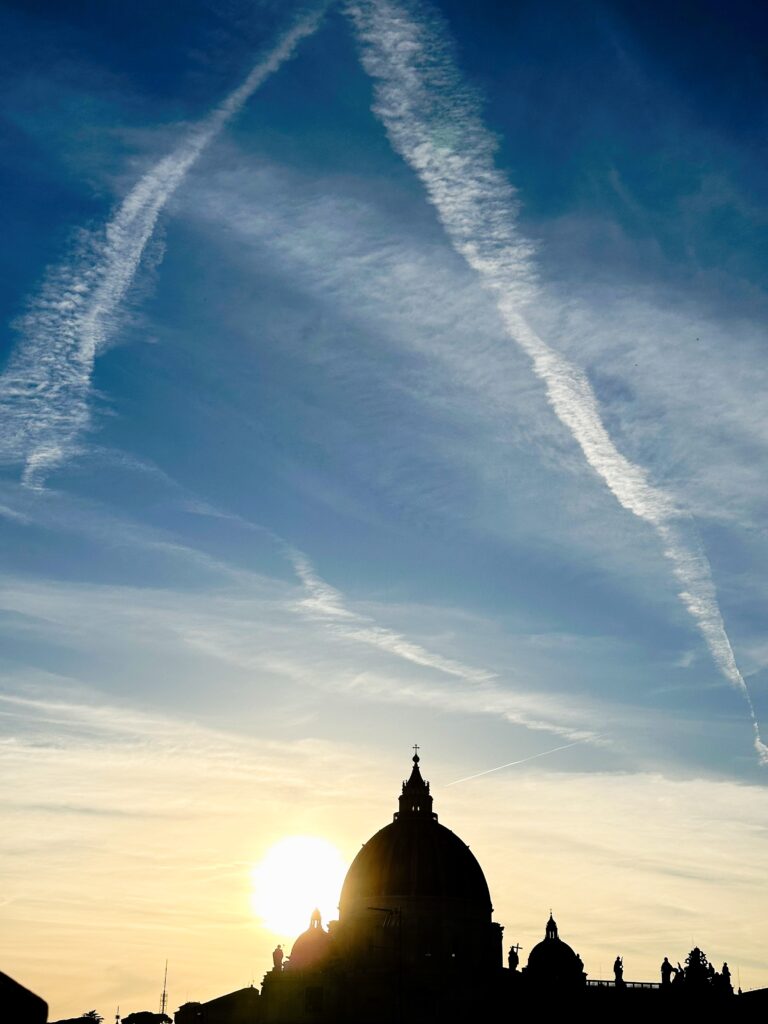
Over the past six years that I’ve lived in Rome, I’ve taken to using my smart phone, as many of us do, for taking pictures. Rome is a particularly lovely and photogenic subject. But no matter what the subject, whether it be St. Peter’s Basilica, one of the other grand churches, the Pantheon, or the Colosseum, one of the keys to a good photo is the “negative space” that frames the subject, and which occupies the distance between the viewer and the view.
Negative space isn’t negative, nor empty. It is like the pause between inhaling and exhaling when we breathe. In fact, in a photo, it is like the breathing space around a subject that helps the brain make sense of shapes, colors, textures, and the orientations of objects. By helping us differentiate between one thing and the next, negative space allows us to focus our attention, to perceive even hidden objects, and to interpret patterns. Negative space is what allows for a relationship between objects, whether close or far. It both separates and unifies the view at the same time. I would go so far as to say that negative space creates the conditions for us to perceive beauty on the way to discovering goodness and truth.
For me, this “negative space” serves as a helpful analogy for considering the spaces and relationships between and amongst the Persons of the Most Holy Trinity, and by extension, the quality of the spaces between each of us, the members of our teams, families, communities, and organizations.
Of course, the Trinity represents a perfection of the space between and amongst one Person and the next. Unlike situations which trigger a teenager to say to her parents, “just give me some space,” or that instigate a person to feel isolated or abandoned, the Father, Son, and Holy Spirit have an ideal distance that allows both their distinct, individuated agency and their shared communion with one another.
This space supports them in playing their particular interdependent roles, creating, sanctifying, redeeming, as if they are members of the highest performing team, of an avant-garde dance troupe, or members of a brilliant jazz trio. They don’t compete, but rather, they collaborate. No one Person has no need to control the others, or steal the show; but rather, like an improvisational comedy troop, each Person is devoted to supporting the others in showing up and performing their best.
The space between them is not empty, full of trust, full of reverence, full of love. These are the shared, mutually enabling conditions that allow them to generate a harmony amongst them, like the resonant union of three distinct cords of music. That space not only allows each Person to be, relate, and function, with each of the others, but in fact, to also be and act as one.
What a beautiful and mysterious thing it is when distinct persons, individuals in the true sense of the word with their own subjectivity, personality, and particular qualities are also able to find spaces to relate to others, and become something more than simply a collection of individuals, but a communion of purpose, agency and cooperation. Hopefully, we have each had experiences of such moments when we have experienced this marvelous balance of being entirely free to be ourselves, and at the same time, parts of a greater whole in a communion of intention and conscious action.
Certainly, we live in times when we experience too much fragmentation due to individualism, groupthink brought on by fearful conformity and ideology, and the polarization that emerges between groups competing for dominance. We need alternatives.
What is required of leaders to cultivate and hold space with and for others to be entirely themselves and at the same time, to experience a fellowship of Spirit, a communion of shared purpose and collective, capable action?
As we contemplate the mystery of this Most Holy Trinity, perhaps it is helpful to ponder how we come to understand the importance of the spaces between and amongst us, spaces of freedom, spaces of reverent trust, spaces of love. If we, as leaders, begin to pay as much attention to the quality of these spaces as we do to the care of individuals and the service of our missions, we will enable our communities and organizations to labor in alliance for the common good, on the way toward the Reign of God.
The grace of the Lord Jesus Christ, and the love of God, and the fellowship of the Holy Spirit be with all of you.
With you on the road,