

Here I thought that I was going to offer a simple reflection on what it meant for the disciples to live in the period of time between the Ascension and Pentecost, as if that would be an easy task. But with more time to pray and consider this question, my frame widened.
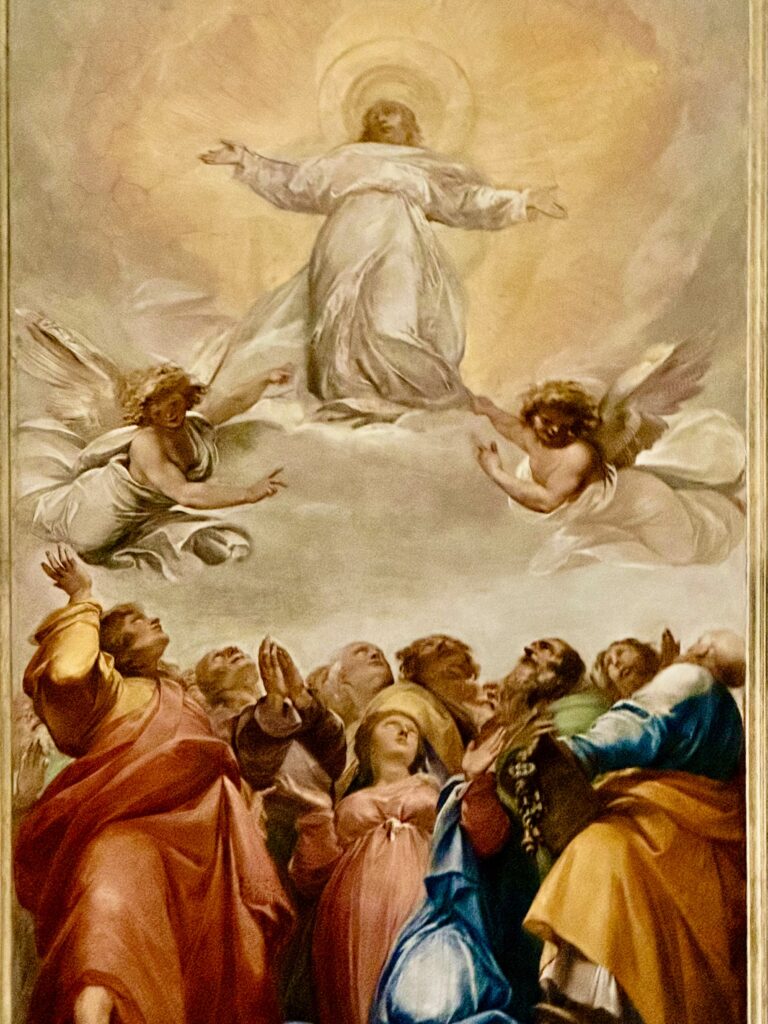
Painting of the Ascension in the Basilica Santa Prassede, by Giuseppe Cesari (1595)
Some close friends of mine who work in the fields of leadership and organizational development are as philosophical as they are practical. For some time, they’ve been exploring what many pundits describe as the “metacrisis,” these dynamics that pose threats to (and opportunities for) the way we live, work, and understand our place in the world. Some of the factors of this meta-crisis include the highly interconnected nature of global economics, geo-politics, and matters of the environment. But we also might add artificial intelligence (AI), which is rapidly shifting the ways we think about education, health care, labor, and virtually every other field that it might influence.
This situation, for lack of a better word, is straining our capacity to make sense of our realities, i.e. “read the signs of the times,” let alone to act. For instance, 25 years ago, when I began facilitating and consulting, we used to formulate “strategic plans” that we expected to guide our organizations for at least five years or more. Now, predicting what the future will look like in five years seems audacious and unrealistic. Instead, we either opt for three year plans, or we steer in the direction of a small handful of mission inspired objectives. We’ve become more humble, more modest, about proposing to create the futures we desire as we acknowledge how turbulent and disruptive our times have become. We focus on what we need to do to maintain “principled agility,” and “creative fidelity” to our missions. Does this sound familiar to you?
Pope Francis suggested that we not think of ourselves as living through times of change, but a change of times, of epochs. One acquaintance of mine, a philosopher of education, posed the suggestive notion that we are living, and consequently, trying to lead in a “time between worlds.” Do you perceive this same sense of being on a threshold, on the edge of something new and yet unknown?
Naturally, the unknown stirs up primitive fears that can be hard to navigate let alone escape. When faced with ambiguity, for instance, we project meaning where there may be none; we make up stories that fulfil our fantasies of what we fear, or if we’re more hopeful, what we dream of. When faced with chaos, we might be tempted to exercise more control over the unknown, or to abdicate our personal responsibility to people more powerful, assuming that they will protect us. When we are at a loss for which direction to go, we might turn to people we believe to be experts, or to quantitative facts and figures which seem like a more solid basis for our decisions. Some of us might be tempted to ask generative AI for the answers we’re seeking, even to the big and existential questions we’re holding.
When the disciples stood at the mountain top looking into the sky as they watched the Risen Christ ascending into the heavens, can we imagine what must have been going on in their minds and hearts at that moment? They must have stood there looking to the heavens for a long time, because in one Gospel account, it took an angel to redirect their attention. Finally, they lowered their gaze and looked to one another, and to the horizon around them.
What now, they must have wondered? What will this mean for me, and for us? What do we do next? We can imagine that they must have experienced a flash of fear, some doubts, and perhaps even a hint of anticipation or excitement. Perhaps they had the presence of mind to recall what they heard Jesus saying as he prayed for them weeks before.
In this passage from the Gospel of John 17, Jesus prays directly to his Father while they’re all together at the Last Supper. This discourse, known as the “High Priestly Prayer,” is Jesus’ way of commending his dear friends to God’s care and keeping, anticipating that many of them would experience the same types of paschal suffering and death that he himself was about to undergo. In a sense, Jesus understood that service to his Father’s Kingdom would mean “living between worlds,” and that the disciples would be rejected as religious and secular powers sought to preserve the status quo. He understood, ironically enough, that as their shepherd, he was leading his flock to the wolves.
But while the disciples may have been a little slow to understand what Jesus was trying to teach them over their years together, they certainly had come to know that the stakes were high, and the mission they had been called to could be dangerous. Far from the promises of the “prosperity Gospel” preached in some parts of the world, rather, the discipleship that Jesus called them to entailed “downward mobility,” self-abnegation, and the embrace of uncertainty. He called them to live a radical adventure of instability, service to others, and to the limits of faith, hope, and love. He called them to live with a kind of abandonment to divine providence, just as he did.
In a sense, this is the perfect preparation for living and leading in these threshold times, between epochs and worlds. Of course, it is also easier to think about than to do. When I reflect on my preferences for predictability, comfort, or control, the radicality of Jesus’ invitation feels intimidating, even impossible. And yet, I find in myself what St. Ignatius of Loyola described as the “desire for the desire,” to grow in this direction of faith in God’s divine providence. I feel a longing for deeper inner freedom from the anxieties that draw me away from living the Gospel more authentically, more generously.
As leaders living in these in-between times, we are invited to turn our eyes to one another and to the horizon, to sense the nearness of Christ’s abiding presence with us, and to live with greater self-abandonment to God’s loving providence in the service of his Kingdom. As we prepare for the celebration of Pentecost, what grace do we require? What freedom? What courage?
With you on the road,