While I’m sure that I had heard the word “sovereignty” in my youth, probably in a history class exploring Western European history in the Middle Ages, the first time I really paid attention to the meaning of the word was in conversation with my friends from the Onondaga Nation, one of the Six Nations of the Haudenosaunee. For them, sovereignty refers to their right to self-governance, in order that their status be recognized and respected not only by the US government, but internationally by the U.N. and other nations.
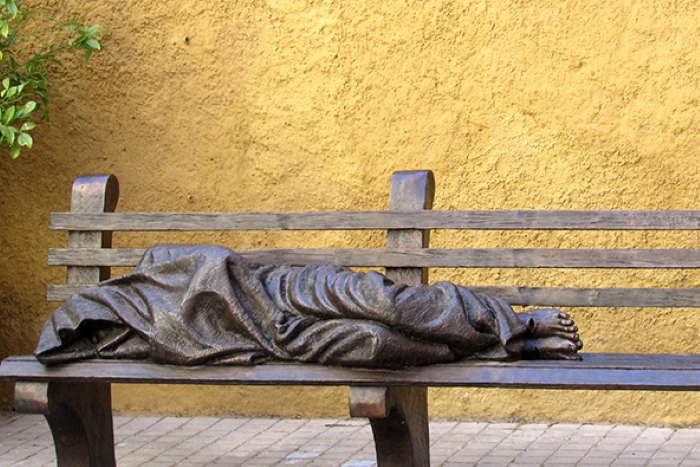
The Homeless Christ by Timothy Schmalz, Rome
Despite all that I thought I knew about the history of indigenous people in North America, including the historical encounters between Jesuits and various tribes and nations, my friends helped me to understand their side of the story, how fragile and precious their sovereignty as a people and a nation is. Despite centuries of trauma, and the dispossession of their lands, still, they safeguard this dignity, their rights, and place in history.
Sovereignty is a right that is only valuable if it is exercised responsibly for those who are governed, and is recognized and protected from infringement by others. It is a kind of power that is contingent, meaning it is dependent on certain conditions to exist. And my friends helped me to better understand just how important it is for them to safeguard their sovereignty as a people with a particular history, culture, and legacy in the larger story of humanity.
When we consider the title of this feast of Our Lord Jesus Christ, King of the Universe, the final Sunday of the Church year before we enter into Advent, what is Christ’s sovereignty and how is it the same or different from others? And what relevance does it have for us today?
In the Church Jubilee year of 1925, when Pope Pius XI instituted the feast of “Christ the King,” he was responding to a historical moment of great turmoil, shortly after the end of the First World War, a time of rising ultra-nationalism, authoritarianism, secularism, and communism. It was also a moment of uncertainty for the status of the Vatican’s own sovereignty as a civil entity in relationship with the Italian state. While surely, the Church would live on, the future of the Vatican was certainly in doubt. (This status wasn’t resolved until 1929 with the Lateran Treaties, which formally severed the Vatican’s former title to the “Papal States,” and limited its territory to the tiny parcel of land that we now refer to as Vatican City, the smallest State in the world.)
Pope Pius XI instituted the Feast of Christ the King as a way of asserting the authority of the Church in the face of these political dynamics. Later, in 1969, another tumultuous time, Pope Paul VI, renamed the feast as we have it today, acknowledging Christ as the King of the Universe. But in fact, the concept of Christ as King is much older than 1925, and much more profoundly theological than political.
As we hear in our Scripture reading today, Ezekiel, the prophet, speaks of the responsible, caring, and just shepherd who will come to judge the peoples. God is the original shepherd, and David, his servant, inaugurated a line of shepherd kings, many of them not so responsible, caring, just, or faithful to their covenant with God and his Chosen people. But we know Jesus is born into David’s spiritual lineage through Joseph, the humble carpenter of Bethlehem. And Jesus in his life and ministry modeled the way a true and faithful shepherd king serves his people, even to the extent of laying his life down for his sheep.
In the second reading from 1 Corinthians and the Gospel from Matthew, the kingship and sovereignty of Christ is not only for Israel, but extends across time and place. His is the only sovereignty that is not contingent, but everlasting. Even though Christ’s sovereignty is understood to have cosmic proportions, his attention, concern, and priority is still for the little ones, the stranger, the prisoner, the outcast and lost. He goes so far as to say that each of these should be treated with the same respect and dignity that he himself would receive if recognized. In the end, Christ will be the final judge discerning the moral character of every person, according to his or her actions, especially toward the poor and vulnerable.
This comes very close to home, literally, this week for me.
At the moment of writing this reflection, I am heartsick to report that a homeless man named Simone died this past week under the gate of the ancient Roman wall adjacent to our Jesuit Curia. He was gentle, kind, and never asked for anything, nor complained. Every day, he would greet passersby, including myself, with a pleasant “Ciao caro,” or “Ciao bella.” Every day he was supported by local volunteers from local charities who tend to the homeless in Rome with food, and if needed medical attention. But Simone seemed resigned to slowly drinking himself to death.
The last memory I have of Simone was of him lying bundled in his blue sleeping bag, so fragile and pale. And I wonder if there could have been something more I or any of us could have done. There, he was, our Lord Jesus Christ, King of the Universe. And am I a sheep or a goat?
We are living in such times that, as in 1925, we might have many anxieties and doubts about the state of affairs, the dynamics of the powers that be, and how things will all turn out. And as in those times, it is good to be reminded that in the end, Jesus Christ is sovereign over all that is, that when all is said and done, he will have the last word as he was the first Word. But most of us are not in a position to sway world affairs, resolve the great problems of our days, or even to know what tomorrow will bring.
But we can mind Jesus’ words in this Gospel, and in our leadership, we can in so many meaningful ways that matter, affect the lives of others for the good. We can recognize the sovereign Christ in the faces of people like Simone, in the migrant family fearing for their lives, the elderly neighbor who has no one to visit her, the prisoner in a local jail, or the sick person awaiting treatment. When we choose to see Christ in others, it is remarkable, but sometimes it happens that we truly encounter Christ in others. These are unforgettable moments that humble us, reminding us of a shared humanity and of our belonging to one another.
In such moments, curiously, there is a sovereignty that arises within us, not of domination but rather of a profound, inalienable dignity that is also in solidarity with others. It is a gift given to us by God to place in service to others, to protect the weak, and feed the hungry, and exercise justice through mercy, and compassion. While it is an inalienable gift and birthright, it can be neglected or forgotten so easily, especially when we surround ourselves with comfort and privilege that can isolate us from others and their needs. But being with people who are living on the edges, under bridges, on the streets, they can remind us who we are and how we are meant to be. Like my indigenous friends, they remind us of the dignity we must safeguard against infringement by any “powers that be,” so that in the end, the good shepherd recognizes us. He recognizes us because we have recognized him in the poor, and we have discovered our shared sovereignty in solidarity.
Fraternally,