


“You’re going to be dead in five years unless you change your diet completely, start exercising every day, and lose at least 30 pounds (15 kilos),” said the doctor to a fellow Jesuit suffering from a severe case of diabetes.
The remarkable thing is that this Jesuit did change his diet, got a very excitable and energetic dog to take on walks every day, and he lost the excess weight in six months. When he returned for his check-up, the doctor was astounded. He asked, “What happened? How did you manage to do this?” My friend replied, “Just the way you said- I took your advice.” And the doctor replied, “I give plenty of advice that nobody takes. What got your attention?” The Jesuit replied, “Well, you did tell me in no uncertain terms that I would be dead in five years, and I took you seriously. I believe in the Resurrection of the Lord, but I’d like to postpone Heaven for a few more years if I have anything to do with it!”
Amazing, no? I can’t even seem to lose 5 kilos!
What motivates people to make such profound changes in their lives, especially in long-term habits and behaviours? What helps us overcome resistances and accept new challenges? How do leaders help people make the shift from the comfort of the familiar to the uncertainty of the new?
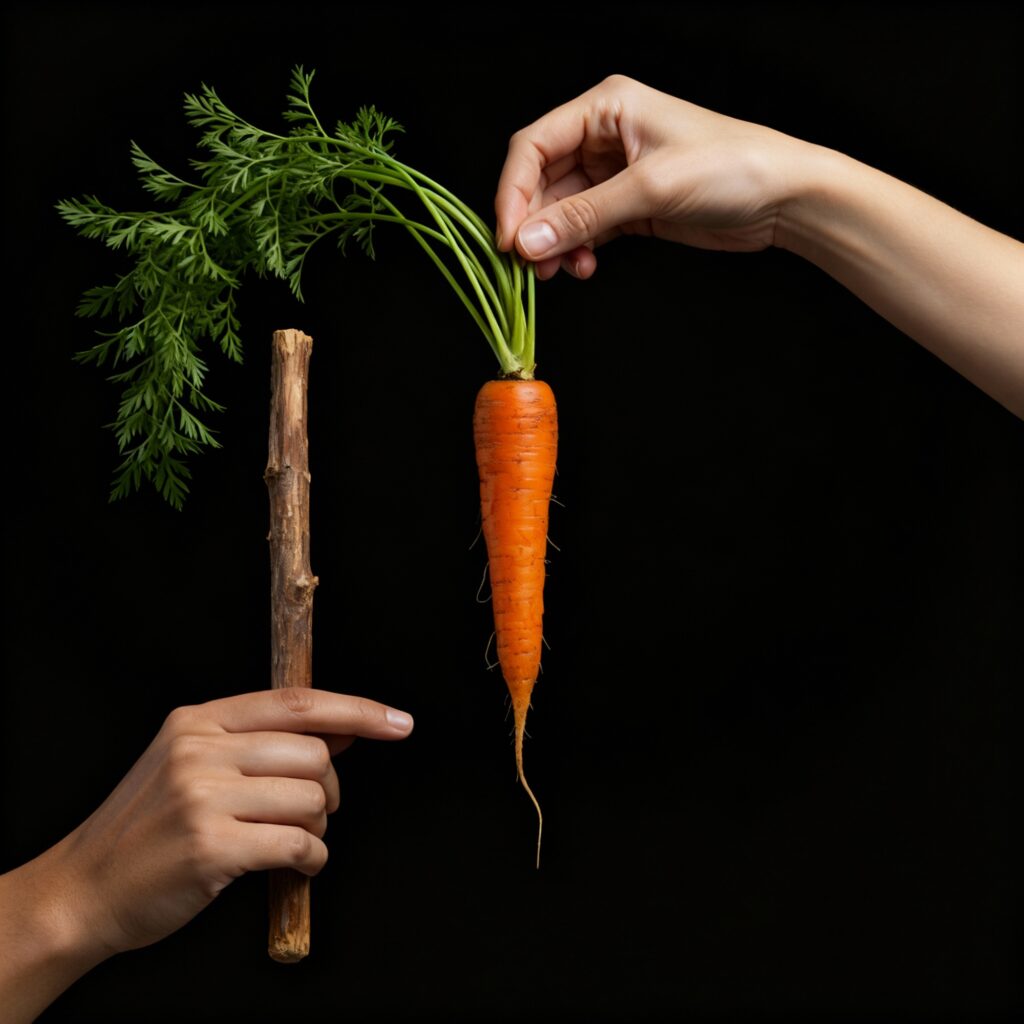
Some say, the “stick,” the threat of the pain that you’re hoping to avoid, is the necessary prod to move us forward. They assume that fear is the most effective way to scare people into making change, of moving out of our comfort zone. The problem is that threats absorb our attention, making us obsess about what we don’t want- failure, criticism, punishment, isolation, etc. The problem is that obsessing about these negative consequences doesn’t help us imagine what we do want, what we long for, our hope-filled vision for the future.
It might work in the short term to startle us into action, as it did my Jesuit brother. But it did not help him envision what it would look and feel like to be healthy, vibrant, or what we would do with the extra years he has. Unfortunately, he continues to have a vision of himself as sickly, weak and frail- despite having lost all that weight.
The “carrot,” by contrast, is dangled in front of us as a way of connecting with our desirable future, what benefits could come from pursuing important change, and how things could be somehow improved if I was to leave my comfort zone, my current attachments. The carrot pulls us forward by attracting us with a positive vision, and often taps our intrinsic, long term values.
In truth, leaders and managers need to know how to use both sticks and carrots to motivate people to make changes, just as we need both to catalyze a shift in ourselves. But both the stick and the carrot remain largely external to us, using threats and rewards as influences to affect our motivations.
John the Baptist, the greatest prophet of the Old Testament, was a transition figure who drew on the traditional tactic of using threats to provoke the conversion of the people. For him, the Kingdom of Heaven was imminent and would begin on a day of Divine Judgment, lit with the fiery Wrath of God. It certainly got people’s attention and even catalyzed the repentance and baptism of crowds who came from far and near to hear his frightening prophetic testimony. Jesus acknowledged the truth of John’s vocation and described him as the greatest man ever born of a woman. And at the same time, Jesus said that the least person in the Kingdom of God would be greater than John.
So, what are we to make of John the Baptist’s preaching as we make our Advent journey, preparing ourselves spiritually for the celebration of the Incarnation at Christmas? How do we respond to John’s threatening use of “the stick” of Divine Judgment?
In truth, I’ve had recent experiences of coming to more honest recognition of the attachments within myself that require transformation by God’s grace. I’ve come face to face with elements of my ego which can be unfavorable for serving others in the way that I desire. In fact, I’ve become acutely aware of my desire for further conversion in humility, for more freedom to having “my way.” I’ve come to understand how much I at times impede cooperation with others and with God because of my own needs. In short, I’ve experienced a “come to Jesus” moment.
It wasn’t John’s stick that so much affected me, but neither was it the “carrot” of some external reward- even the promise of Heaven. For me, the motivation is my desire to live and love from a place within Jesus’ Kingdom more than according to my own self-referential plans. I don’t deny that, at times, I might need the stick to get my attention at first, and carrots are certainly nice but in the long run, when I’m on the way, it is the inner desire that keeps me moving in the right direction.
So perhaps this is John the Baptist’s role in history of salvation- to get our attention, to help us take note as to whether we are on the road and ready to meet the Lord on his Way, ready to receive his Word and instruction, ready to more and more embrace his will and make God’s desires for ourselves and our world our own deep and motivating desire for how we live, love, and lead.
As we take another step in the Advent journey, has John gotten our attention? Are we on the way and moving in the right direction? Or do we need to examine the places of resistance and conversion within ourselves? Where do we need the stick? Where do we need the carrot? Or where might we need even more to enkindle our desires to join with God’s for the coming of his Kingdom?
With you on the Advent journey,