
We might hear in popular culture and especially in new age spirituality how important it is to “be in the now.” And really, this isn’t bad advice, is it? But it certainly is nothing new. Many saints and mystics over the ages have suggested similarly what a gift it is to discover the “sacrament of the present moment.”
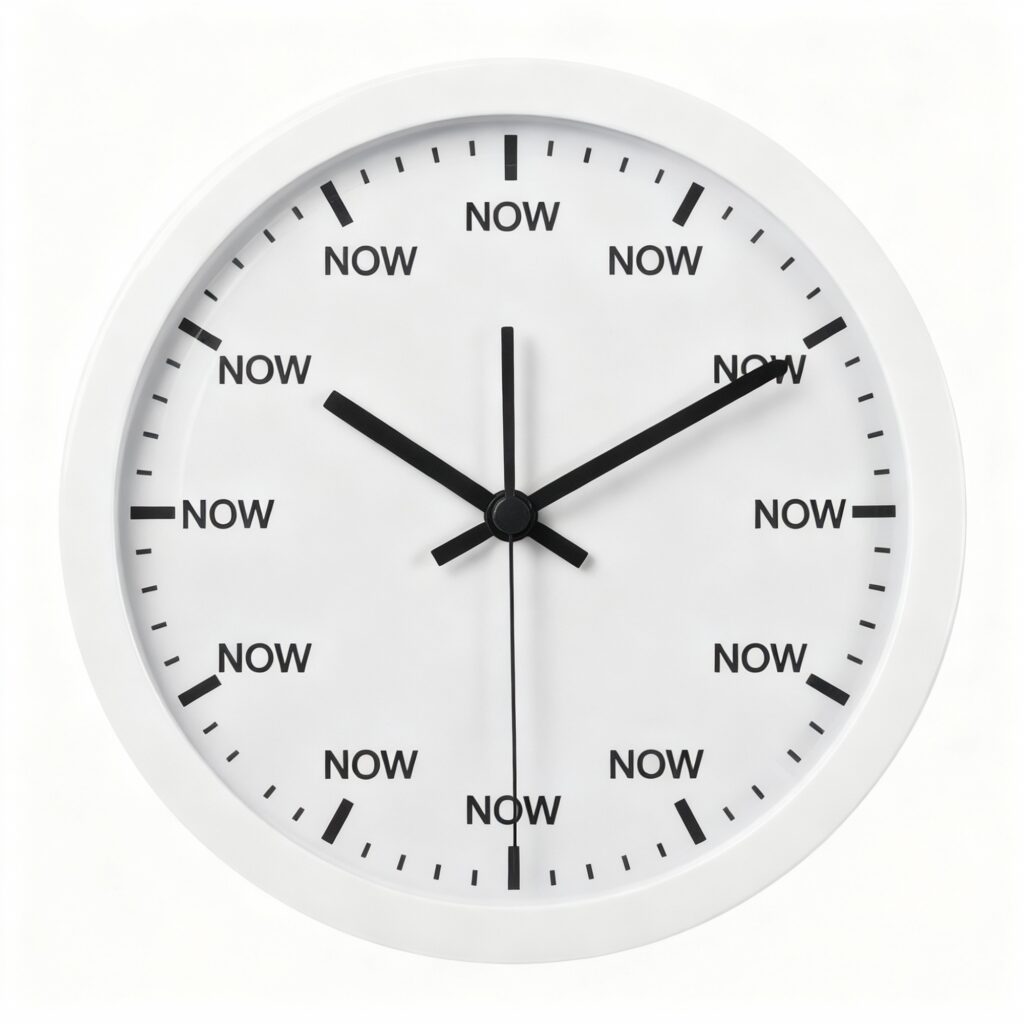
Whether we allow our attention to be absorbed entirely by what we’re doing at that very moment, maybe doing some mundane task like ironing our clothes, washing the dishes, or attentively listening to the person in front of us, we can find a pleasure and satisfaction, and perhaps even that God is present right there and then. In fact, there is a kind of contemplative wisdom that transcends many religious traditions which suggests that God is really nowhere else to be found except in the ever-present now of this moment, and the next, and the next.
In the Christian tradition, we hold a “two clocks” perspective on time. One clock is measuring each second, minute, hour, day, and so on in a linear way, counting each in a cumulative way like grains of sand in an hourglass (remember those?). We call this “chronos” time, after the Greek tradition of the god of time. But there is another perspective, that of “kairos,” which suggests a timely, even critical moment for decision or action. This sense of timing is not just understood in the practical sense of being a good or even perfect moment to act… like knowing when to stop boiling an egg, or when to take the dog outside. It is understood as a moment of Divine fullness, a moment of revelation, a moment when, in a flash, everything changes.
In our Gospel for this first Sunday of Advent, Matthew paints a somewhat startling picture of people going on about their business, farming their fields, grinding their grain, and without warning, without being able to account for either the suddenness nor for selection of one person or the next, everything changes.
Now, of course, our brains are wired to immediately interpret this scene as one that is threatening, and a reason for fear, for vigilance. And in fact, Jesus seems to underline this when he uses the example of the thief in the night, waiting for our guard to go down, when he breaks into our house and robs us in the dark. There was context for this kind of vigilance in Matthew’s own time, as this Gospel was written during a period of persecution for the early Jewish converts to Christianity. So indeed, there was a warning that people should always be on guard.
However, over time, especially without the sense of an impending doom of crisis and persecution, theologians and spiritual guides began to understand how Jesus calls us to live with a different kind of vigilance. This vigilance is not so much about waiting in a state of anxiety and fear, but more about “keeping vigil,” staying awake for the way God can come to us at any moment, and at any moment, we can choose to be ready.
This vigilance is more of a moral vigilance, as in a readiness to act as a mature disciple would, with holiness, compassion, and selfless generosity, no matter what the circumstances. Saints and mystics over the years have taken this instruction to heart and made a point of practicing this readiness, in prayer, but also in service to strangers and neighbors in moments of need. Every moment becomes a kairos moment, where the Kingdom of God becomes present in the action of imitating Christ when we have the chance to do so. And when you think about it, in every moment, we have that opportunity, that potential.
Several years ago, Pope Francis referred to the situation of a Vietnamese Cardinal, François-Xavier Nguyên van Thuân, who had been imprisoned by the Communist government, yet he decided to see his unjust incarceration as a kairos moment. “When he was imprisoned, he refused to waste time waiting for the day he would be set free. Instead, he chose ‘to live the present moment, filling it to the brim with love.’ He decided: ‘I will seize the occasions that present themselves every day; I will perform ordinary actions in an extraordinary way’.
For us as leaders, we know that timely action is a virtue. Knowing where, when, how, and why we decide to take action requires discernment, experience, and intention. We also know that it’s easy to fall into routines, go through our days on autopilot, or resort to old habits and patterns of actions that are more comfort centered than attuned to what is needed now. As leaders, we can fall into presumption, cynicism, and lose hope that the future will look any different from the past. We can get lazy and complacent, and focus on the moment in ways that are unhelpful – indulging in a more hedonistic way of living that doesn’t look to the needs of tomorrow.
But Jesus rouses us from this drowsy, inattentive, and self indulgent wasting of time. He encourages us to live like the holy Vietnamese Cardinal, who chose, despite his terrible circumstances, not to wait until what the world would say was an opportune moment to demonstrate his faith, hope, and love. He chose to witness even then to the love of God and neighbor, and to see every day, every moment, as a space to live, love, and lead in an imitation of Christ.
As we begin our Advent preparations for the celebration of the Incarnation, where are we feeling called to rouse ourselves from sleep, from self preoccupation or indulgence? How might we choose to “keep vigil,” watching for opportunities to imitate Christ in our daily lives and routines, and leaning into a kind of holiness that feels new, invigorating, and timely for the service of others? The moment awaits. Are we ready?
With you on the journey,